
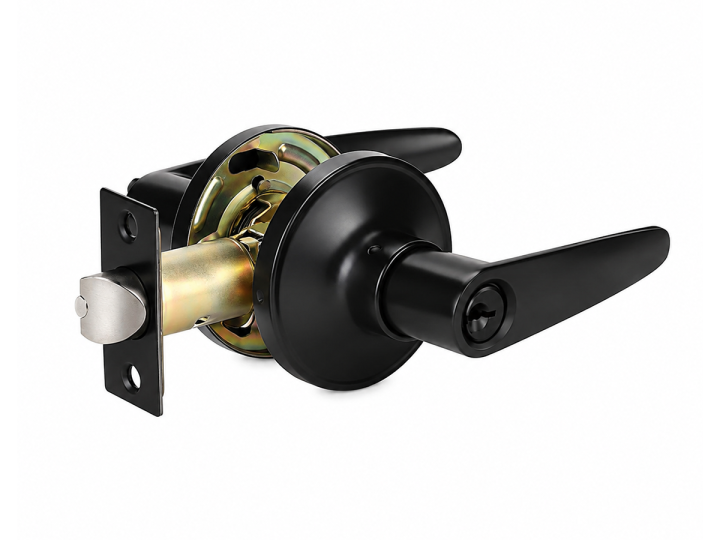
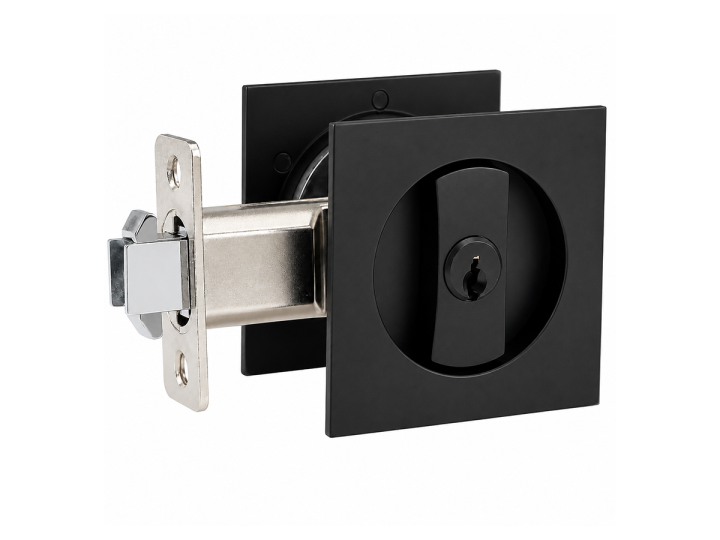
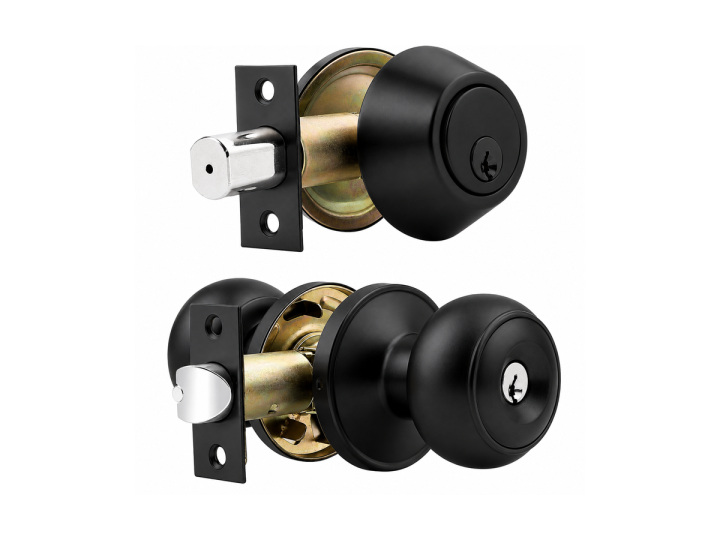
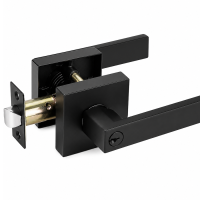
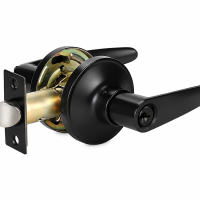
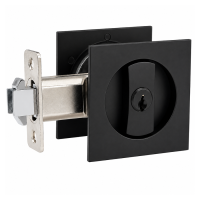
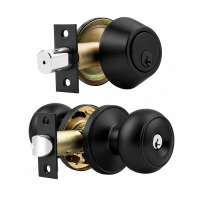
A deadlatch is an ordinary spring latch with one extra part — a small plunger beside the bolt — and that part is the difference between a door that can be opened with a shim and one that cannot.
What a spring latch is
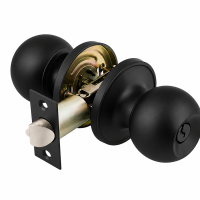
A spring latch, sometimes called a plain latch, is a single bevelled bolt pushed out by a spring. Close the door and the bevel rides over the strike lip, the bolt springs into the strike opening, and the door is held. Turn the knob or lever and a retractor pulls the bolt back. Typical throw on a tubular latch is 1/2 in (12.7 mm); some heavier chassis use 5/8 in (16 mm).
Mechanically it is simple and reliable. As a security device it has one well-known weakness. Because nothing holds the bolt in the extended position, anything thin and stiff pushed into the gap between door and frame can press on the bevel and drive the bolt back into the case. This is called loiding, or in ordinary language, carding the lock. It takes a few seconds and leaves no damage.
What a deadlatch adds
A deadlatch puts a second, smaller plunger in the same faceplate, immediately beside the main bolt. It is often called the auxiliary latch, the deadlocking plunger or the anti-shim pin. It works like this:
- With the door open, both the bolt and the plunger stand proud.
- As the door closes, the bolt drops into the strike opening but the plunger lands on the solid face of the strike plate and is pushed in.
- Depressing the plunger throws an internal blocking element behind the main bolt. The bolt can still be retracted by the knob, lever or key, but it can no longer be pushed straight back from the bevel.
Slide a card in now and it does nothing. The bolt is mechanically dead-locked against inward pressure until the plunger is released by opening the door.
The failure mode nobody checks
The plunger only works if it lands on metal. If the strike is fitted a few millimetres out of position, or the strike opening is cut oversize, or the door-to-frame gap is too wide, the plunger drops into the strike opening alongside the bolt. It is then not depressed, the blocking element never engages, and you have paid for a deadlatch and installed a spring latch.
This is the single most common defect we see in photographs sent with security complaints. Two rules cover it:
- The plunger must be fully depressed with the door closed. Check by eye with the door ajar and a torch, or by pressing the closed bolt through the gap — it should not move.
- Keep the door-to-frame gap at or under 1/8 in (3 mm). Beyond about 3/16 in (5 mm) the plunger commonly misses.
Where the frame has already been cut oversize, a strike with a longer solid lip, or a strike box with a raised land beside the opening, usually recovers the situation. It is worth carrying a few in the site box.
Where the standards sit
ANSI/BHMA A156.2 covers bored and preassembled locks and includes requirements aimed squarely at this behaviour for keyed functions — the latch has to resist a defined end-load without retracting. A156.5 covers auxiliary locks and deadbolts, where the minimum bolt throw for the graded product is 1 in (25.4 mm). In Europe, EN 12209 classifies lock cases with a multi-digit code that includes bolt security and endurance; it does not use the word deadlatch, so read the classification rather than the marketing sheet.
None of these standards makes a deadlatch automatically secure. They test the mechanism, not the installation, and as above the installation is where it usually fails.
Deadlatch, deadbolt and deadlocking are three different words
The vocabulary causes real confusion in specifications and in quotations. Keeping them apart:
| Spring latch | Bevelled bolt, spring return, no anti-shim feature. Throw usually 1/2 in (12.7 mm). |
|---|---|
| Deadlatch | Spring latch plus auxiliary plunger that blocks the bolt when the door is closed. Same throw. |
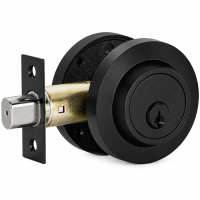
| Deadbolt | Square-ended bolt with no bevel and no spring. Thrown only by key or thumbturn. 1 in (25.4 mm) throw for graded product. |
| Deadlocking | An adjective, applied to either a latch or a bolt. On its own it tells you nothing about which part you are buying. |
A deadlatch resists shimming. A deadbolt resists shimming, jamb spreading and a great deal of force, because the bolt is longer, has no bevel to push against and is not connected to the handle at all. They are complementary, not alternatives. An external door specification that names a deadlatching entrance lock and a separate deadbolt is doing the right thing.
Where a plain spring latch is still the right choice
Deadlatching is not free — it adds a part, a spring and an assembly step — and it is not always useful:
- Passage and privacy functions. An interior door with no key has nothing worth shimming. A plain latch is lighter and quieter.
- Doors inside a controlled boundary. Office doors behind a secured reception, hotel guest room bathrooms, cupboards.
- Where the strike geometry cannot support it. Some narrow aluminium frames simply do not offer enough solid strike face. A deadbolt is the better answer there.
Conversely, treat a deadlatch as mandatory on any keyed exterior door, any glazed door where the gap is visible, and any door on an outward-facing corridor in a multi-occupancy building.
Anti-friction latches, a related part
On mortise locks you will also meet an anti-friction latch: a roller or sprung tongue set into the face of the main bolt, whose job is to reduce the force needed to close the door against a seal or a closer. It looks a little like a deadlatch plunger and does something completely different. If a drawing shows two features on the bolt face, ask which one it is.
Our practice
Every keyed entrance function in our catalogue ships with a deadlatching latch as standard, in both 2-3/8 in (60 mm) and 2-3/4 in (70 mm) backsets, and we cycle-test the plunger with the latch in our own lab rather than testing the bolt alone. Passage and privacy functions ship with a plain latch unless a project asks otherwise.
Three symptoms and their usual causes
Deadlatch complaints arrive described in three ways, and each maps to a different fix:
- “The door can be opened with a card.” Nine times out of ten the plunger is dropping into the strike opening. Check the strike position and the gap first; only after that suspect the latch.
- “The door will not open from inside without lifting the leaf.” The bolt is binding on the strike lip because the leaf has dropped or the hinges have worn. The deadlatch is not the fault, but it makes the symptom worse because the blocked bolt cannot give at all.
- “The plunger has stopped springing out.” Usually paint or plating debris in the faceplate slot after a site respray, occasionally a bent plunger from the door being forced closed against a misaligned strike. Replace the latch rather than trying to free it.
Checklist before you sign off a door
- Is the function keyed? If yes, a deadlatch is expected.
- With the door closed, is the auxiliary plunger fully depressed?
- Is the door-to-frame gap 1/8 in (3 mm) or less?
- Does the plunger land on solid strike face, not on the opening or on a lip cut-out?
- Is the strike box deep enough that the bolt reaches full throw?
- On exterior doors, is there also a deadbolt with a 1 in (25.4 mm) throw?
- Have you confirmed which latch throw the frame prep was cut for — 1/2 in or 5/8 in?



Leave a Reply