
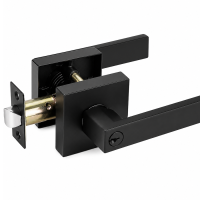
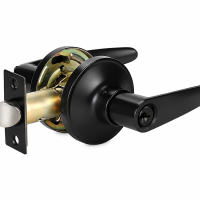
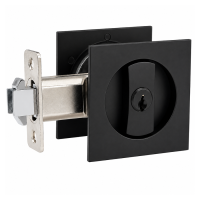
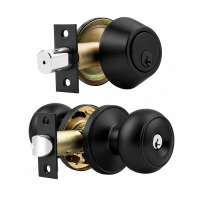
There is no such thing as a fire-rated lock on its own: the rating belongs to a tested door assembly, and a lock is only ever listed as a component that assembly is permitted to contain.
The assembly is what gets rated
A fire door rating — 20, 45, 60, 90 or 180 minutes in North America, or E30, EI30, E60, EI60 and so on in Europe — is awarded to a complete assembly tested in a furnace: door leaf, frame, hinges, latching hardware, seals, glazing and the anchoring method, all together. Change a significant component and the test no longer describes what you installed.
This is why a supplier who says “our locks are fire-rated” is, at best, using shorthand. The honest form of the statement is: this lock model has been tested as part of specified assemblies, is listed by a named body, and may be used within the limits of that listing. Ask for the listing reference and the limits. If neither exists, you are looking at a marketing claim.
The two test regimes you will meet
| North America | NFPA 252 or UL 10C (positive pressure) for the fire test; UL 10B is the older neutral pressure method. Installation and maintenance rules come from NFPA 80. Listings from UL, Intertek/Warnock Hersey, FM. |
|---|---|
| Europe | EN 1634-1 for the fire resistance test of door assemblies, with the result classified under EN 13501-2 as E, EI1 or EI2 plus a time. Product standards such as EN 12209 (lock cases), EN 1906 (levers and knobs) and EN 1935 (hinges) carry a digit indicating suitability for use on fire doors. |
The two systems are not interchangeable and one does not convert into the other. A 60-minute EI60 European assembly is not a “60-minute UL” door. If a project drawing quotes one and the submittal quotes the other, that is a question to raise, not a detail to smooth over.
Read the classification digit, not the headline
European product standards use a multi-digit classification code, and one of those digits deals with fire. In EN 12209 and EN 1906 there is a position that is either 0 — not approved for use on fire or smoke doors — or 1 — suitable, based on evidence from EN 1634-1 testing. EN 1935 for single-axis hinges works the same way, with a grade covering fire door suitability. The digit is the answer. A CE marking on its own does not tell you the product is for fire doors; it tells you the product has been assessed against a harmonised standard, and part of that assessment is the digit you should be reading.
When we send a declaration of performance for our EN 12209, EN 1906 or EN 1935 classified products, that digit is on it. Read it, and if a project needs a value the certificate does not show, treat that as a no rather than an assumption.
Positive latching is the mechanical requirement
Whatever the regime, the physical job of the hardware on a fire door is the same: hold the leaf tight in the frame while the leaf tries to deform. That produces a small number of very practical rules.
- The door must be self-closing and must positively latch. A door held only by a roller catch, a magnetic catch or friction is not latching.
- NFPA 80 sets a minimum latch throw of 1/2 in (12.7 mm) for fire door latching hardware. Longer is generally better because the leaf will bow.
- A deadbolt does not satisfy the latching requirement, because a deadbolt depends on someone having thrown it. It may be present, but a self-latching bolt must also be there.
- Nothing on the door may prevent it closing and latching from any position. That rules out most hold-open arrangements unless they release on alarm.
- Materials in the latching train matter. Latch cases, bolts and hubs are steel on tested assemblies. Decorative parts may be zinc alloy; the load path should not be.
Hinges are part of the rating too
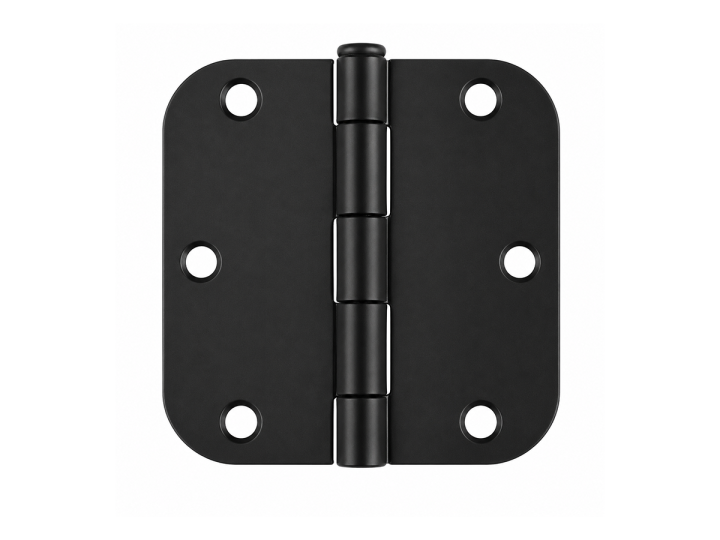
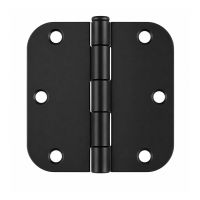
Hinges hold the leaf in the frame for the whole test. Fire door assemblies almost always call for steel hinges, commonly ball bearing, in a stated quantity — usually a minimum of three on a standard-height leaf and more on tall or heavy doors. Brass and aluminium hinges are not normally acceptable unless the specific assembly was tested with them. Intumescent hinge pads are a feature of many European tested assemblies and are supplied with the door, not with the hinge.
What you may and may not cut on site
This is where a good hardware package gets ruined. NFPA 80 permits a limited amount of job-site preparation on a labelled door — broadly, holes up to 1 in (25.4 mm) diameter for surface-applied hardware, plus the function holes needed for mortise locks, cylinders and viewers, with the rest to be done by the door manufacturer or a listed shop. Anything larger, and any cut into a rail or the top of the leaf, generally voids the label. In Europe the equivalent restriction comes from the assembly’s field of application: if the tested evidence did not include a given cut-out, you may not make it.
Practical consequence for buyers: get the door prep right at the door factory. Specify the lock and its prep before the doors are made, not after they arrive.
Non-compliances that turn up repeatedly
Most fire door hardware failures found on inspection are not exotic. They repeat:
- A latch that does not engage because the strike is misaligned, so the door rests against the stop instead of latching.
- Kick plates, viewers or letter plates cut into a labelled leaf on site, outside the permitted preparation.
- Brass or aluminium hinges substituted for steel during a finish change, with nobody re-checking the fire evidence.
- A door held open with a wedge or a hook because the closer is too strong — the closer gets removed, and the door is now neither self-closing nor latching.
- Hardware swapped for a visually similar model late in a project, with the submittal never updated.
- Smoke seals painted over or omitted, which affects the smoke classification rather than the fire rating, but fails inspection just the same.
None of these is a manufacturing defect. All of them are specification and installation control, which is why the paperwork trail from tested assembly to delivered door matters more than any single certificate.
What honest sourcing looks like
Our own scope is straightforward and we state it the same way on every quotation. We hold ISO 9001:2015, test to ANSI/BHMA A156.2 and A156.5 at Grade 2, and CE mark to EN 12209, EN 1906 and EN 1935. Fire listing is a separate scheme with separate test evidence, and where a project needs it we will tell you what evidence exists for the specific model rather than let a general certificate stand in for it. A supplier who answers “yes, all fire rated” to a question about a whole catalogue is not a supplier you want on a fire door package.
What to ask for, and what to send us
- Required rating and regime — for example 90 minutes to UL 10C, or EI60 to EN 1634-1 / EN 13501-2.
- Door construction: timber, timber composite or hollow metal, and the door manufacturer’s name.
- Whether the door manufacturer’s tested assembly names specific hardware or accepts a category.
- Leaf size and weight, single or double, and whether there is a mullion.
- Latch throw required by the assembly.
- Hinge quantity, size and material called for by the assembly.
- Any smoke control requirement, which is a separate test from fire.
- Confirmation of who is doing the door prep — factory or site.
Leave a Reply