
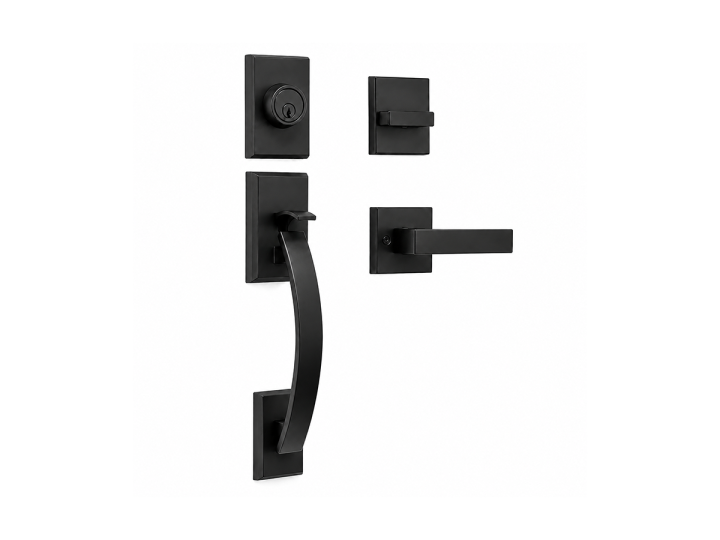
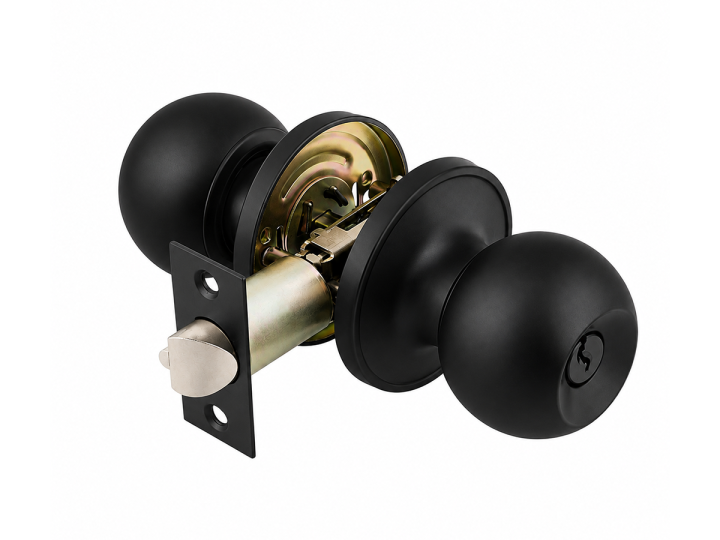
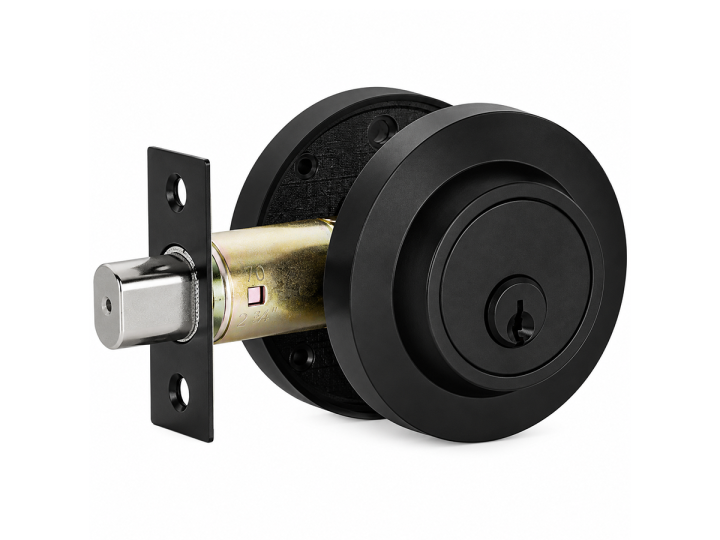
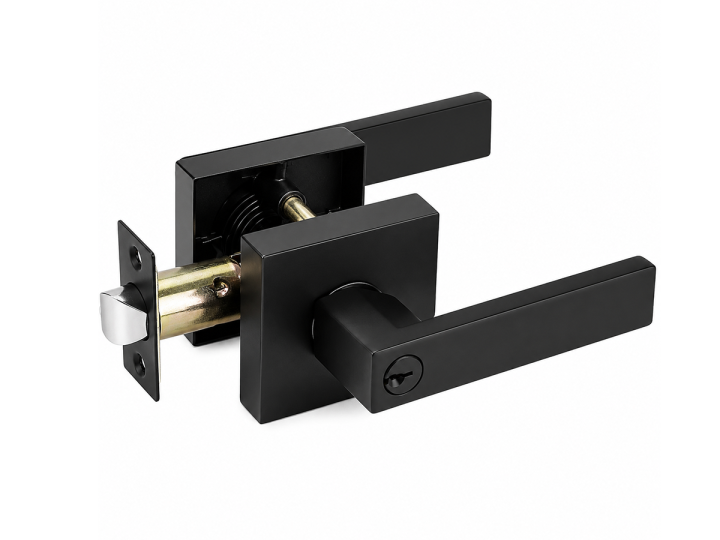
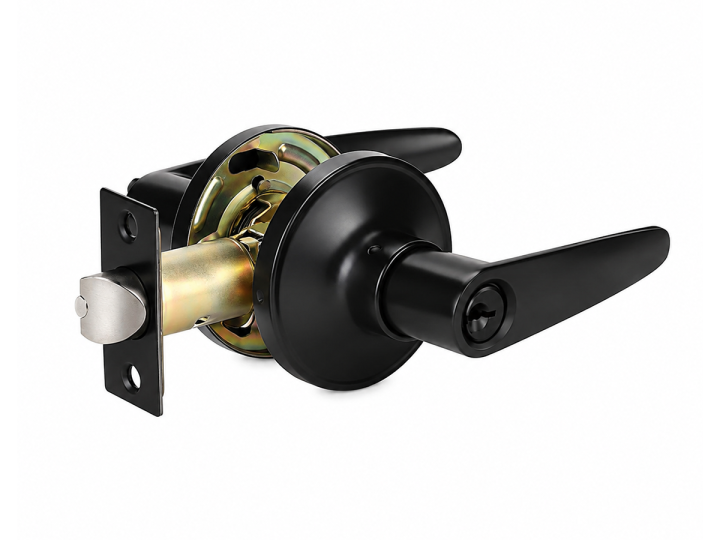
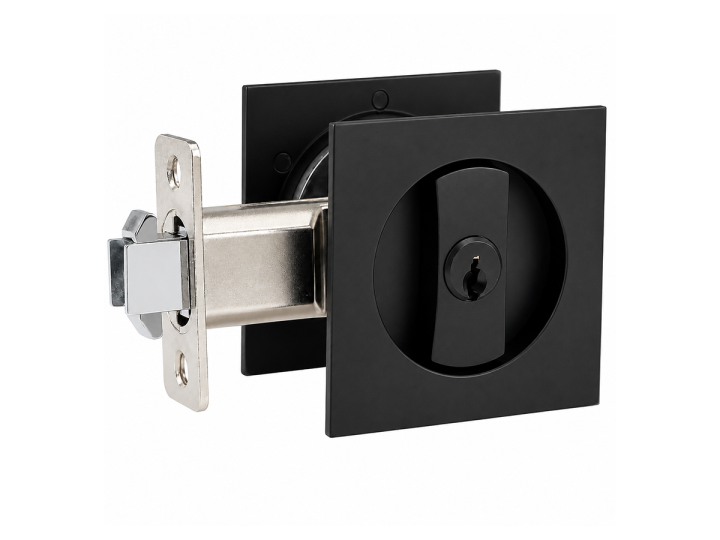
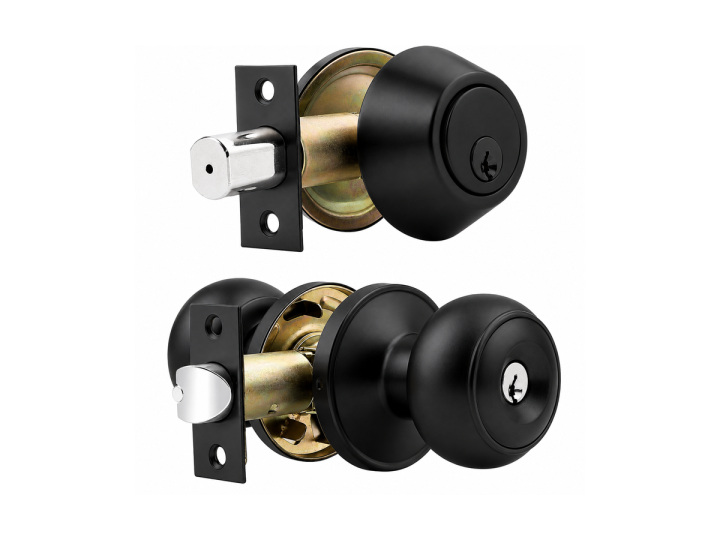
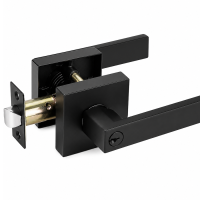
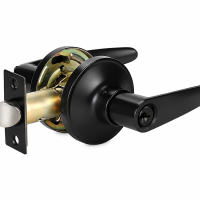
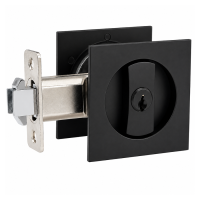
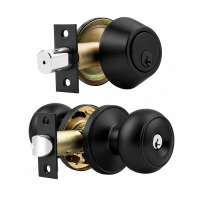
Almost every fit-up complaint we receive comes down to four numbers: the cross bore, the edge bore, the backset and the strike prep — and to the tolerances around them rather than the nominal sizes themselves.
The three machined features
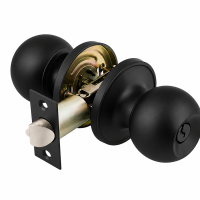
A cylindrical lockset — knob, lever, or a handleset built on a tubular chassis — needs three separate features cut into the door. They are independent operations, and a door can be right on two of them and wrong on the third.
- Cross bore (face bore): 2-1/8 in (54 mm) diameter, drilled through both faces. This is the dominant convention in North America and in most export markets that follow it.
- Edge bore (latch bore): 1 in (25.4 mm) diameter, drilled into the lock edge on the door’s centreline until it meets the cross bore.
- Latch face mortise: a shallow rectangular pocket around the edge bore for the latch faceplate, normally 1 in x 2-1/4 in (25.4 x 57 mm).
Some light-duty passage and privacy sets, and a good deal of older stock, use a 1-1/2 in (38 mm) cross bore instead. If you are replacing hardware rather than specifying a new door, measure before you order. Going from 1-1/2 in to 2-1/8 in is a simple re-drill; going the other way needs a cover plate.
Backset: why there are two standard numbers
Backset is the distance from the door edge to the centre of the cross bore. Two values dominate:
| 2-3/8 in (60 mm) | Residential doors and most interior applications |
|---|---|
| 2-3/4 in (70 mm) | Commercial doors, hollow metal frames, wider stiles |
| Adjustable latch | One latch covers both by extending the tube; supplied as standard on most of our tubular ranges |
Adjustable latches solve the ordering problem but create a checking problem: at the 2-3/4 in setting the latch tube is longer, so the edge bore has to be drilled deeper — usually around 3 in (76 mm) rather than 2-5/8 in (67 mm). A door bored only for the short setting will not take the long one. On glazed or narrow-stile doors, check the backset against the stile width before anything else; a 2-3/4 in backset needs a stile wide enough for the rose or escutcheon as well as the bore.
Door thickness and spindle length
The two standard thicknesses are 1-3/8 in (35 mm) and 1-3/4 in (44 mm). Most cylindrical hardware ships to cover roughly 35–45 mm without any change of parts, because the spindle and the mounting screws have enough range. Outside that band you need a longer spindle and longer screws, and on very thick doors a longer cylinder tailpiece as well. Say the thickness on the enquiry; it costs nothing to supply the right length in the box and a great deal to ship it afterwards.
Latch face, radius corners and drive-in collars
The faceplate is a small part that causes a disproportionate number of returns. Three details matter:
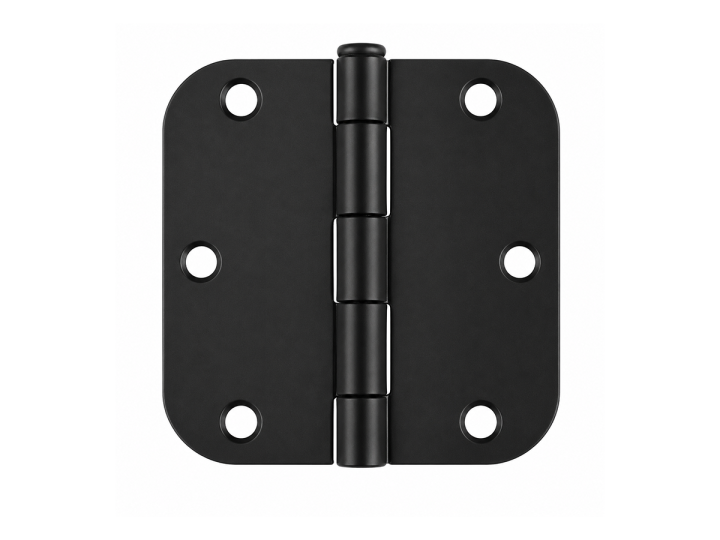
- Corner shape. Square corners suit a chisel-cut mortise; radius corners suit a router. The common radius is 1/4 in (6 mm), but 5/32 in (4 mm) also exists. A radius plate in a square mortise leaves visible gaps at the corners.
- Mortise depth. Cut to the plate thickness, typically 2.5–3 mm, so the plate finishes flush. Proud of the door edge, it will foul the frame; sunk too deep, the latch bolt loses throw.
- Drive-in collar. On pre-machined metal doors the faceplate is replaced by a 1 in (25.4 mm) circular collar that is driven into the edge bore, with no mortise at all. It needs a bore on the tight side of tolerance to hold; an oversized bore will not retain it.
Strike preparation
The strike is the half of the job that belongs to the frame supplier, which is exactly why it goes wrong. Three types cover almost everything:
| Full-lip / T strike | 2-1/4 in x 1-1/8 in (57 x 29 mm), wood frames, residential |
|---|---|
| ANSI (ASA) strike | 4-7/8 in x 1-1/4 in (124 x 32 mm), hollow metal frames, square or radius corners |
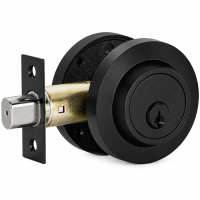
| Deadbolt strike | Same plate footprint options, with a box or pocket deep enough for a 1 in (25.4 mm) bolt throw |
Two dimensions on the strike are worth checking on every job. First, lip length: measured from the screw centreline to the outer edge of the lip, it has to clear the door stop so the latch is not deflected. Second, pocket depth: allow the full bolt throw plus about 1/16 in (1.5 mm). A deadbolt with a nominal 1 in throw that only enters 5/8 in because the pocket is shallow has lost most of its resistance.
Height off the floor
There is no single mandated height, and it helps to say so rather than quote a figure as if it were law. The usual conventions are:
- Residential lock centreline: 36–40 in (915–1015 mm) above finished floor.
- Commercial hollow metal doors: 40-5/16 in (1024 mm) to the centre of the 2-1/8 in bore is the widely used figure, because it matches standard frame reinforcement positions.
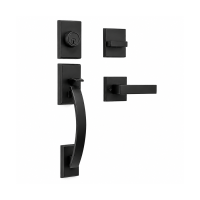
- Deadbolt above lockset on a two-bore door: 5-1/2 in (140 mm) centre to centre is common. Handlesets are usually fixed at either 5-1/2 in (140 mm) or 3-5/8 in (92 mm) centres, so this is a catalogue number, not a free choice.
- Accessibility rules in several markets require operable hardware between roughly 34 in and 48 in (865–1220 mm) above floor. Check the local code; the numbers differ.
The tolerances that actually cause site problems
Nominal dimensions are rarely the issue. These are:
- Edge bore alignment. The edge bore must intersect the cross bore centrally. More than about 1 mm off and the latch tailpiece binds against the chassis, which reads on site as a “stiff lock”.
- Perpendicularity. A cross bore drilled a couple of degrees off square makes the rose sit unevenly and puts the spindle in bending. Freehand drilling without a jig is the usual cause.
- Door-to-frame gap. Keep it at or under 1/8 in (3 mm). Beyond that the latch engages less of the strike and, on a deadlatching latch, the auxiliary plunger may not be depressed at all.
- Edge bevel. A 1-3/4 in door is normally bevelled 1/8 in in 2 in on the lock edge. The faceplate mortise must follow the bevel, not the square.
- Hollow metal reinforcement. The lock case bears on the internal reinforcement, not the skin. If the reinforcement is missing or displaced, the rose screws pull the skin in and the lock rocks.
If the door is metric and mortise-prepped
Doors prepped for Euro-profile mortise cases follow a different set entirely. The usual reference points are a 92 mm centre distance between the spindle and the cylinder, a 17 mm cylinder profile height, an 8 mm square spindle, and a forend of 24 mm width. Backsets on mortise cases are commonly 45, 55, 60 or 65 mm. None of this interchanges with a 2-1/8 in tubular prep, so the door has to be committed one way or the other early. We build and test to both families, but the decision must be made before the doors are machined.
What to send us with an enquiry
- Door thickness in millimetres or inches, and whether it varies across the project.
- Backset required, or confirmation that an adjustable latch is acceptable.
- Cross bore diameter if the doors are already machined.
- Faceplate: square or radius corner, or drive-in collar.
- Strike type: T strike, ANSI 4-7/8 in, or a frame manufacturer’s own prep drawing.
- Frame material: timber, hollow metal, aluminium.
- Lock centreline height, and deadbolt centres if a two-bore door.
- Any existing door prep drawing as a PDF or DXF — one drawing removes a week of emails.
Leave a Reply